Real-Time Streaming as the Context Layer for AI Agents

Empower LLMs with Up-to-the-Millisecond Data Awareness
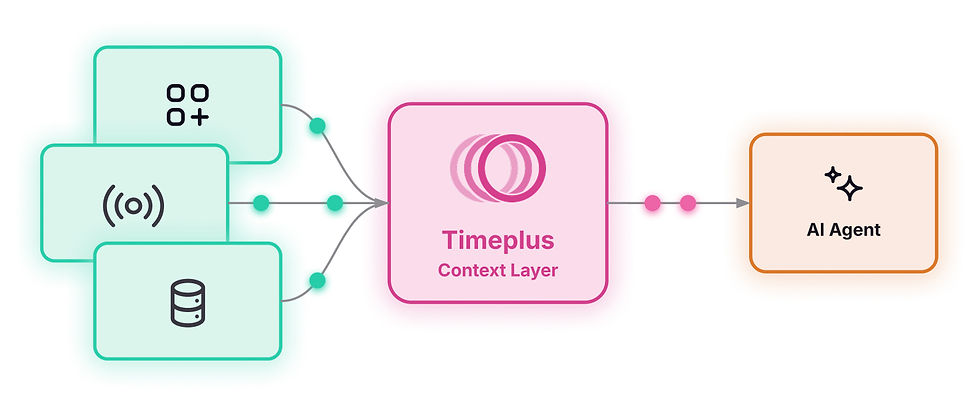
Most enterprise AI projects fail — not because the models are weak, but because the data feeding them is stale. MIT's 2025 State of AI in Business report found that 95% of enterprise AI initiatives deliver zero return. The root cause is a gap between what AI agents know and what is actually happening in the business right now. Gartner and Confluent both call this the "context gap." A wave of streaming-native platforms is now racing to close it. Timeplus, Confluent Intelligence, StreamNative's Orca, and Redpanda's Agentic Data Plane each offer a different architecture for the same goal: giving AI agents live, continuous awareness of operational reality.
IBM's $11 billion recent acquisition of Confluent made the stakes clear. The center of gravity in AI infrastructure is shifting. Model intelligence alone is not enough. Data infrastructure — particularly real-time data — is becoming the defining layer.
The conventional approach for grounding AI agents has been Retrieval-Augmented Generation, or RAG. RAG works well for its original purpose: searching through documents. But operational systems need something fundamentally different. They need data that moves continuously, arrives in milliseconds, and carries a sense of time. That is what streaming platforms provide.
This does not mean RAG is obsolete. The two approaches serve different needs. RAG handles static knowledge bases and historical documents. Streaming handles live operational state. The strongest production architectures combine both.
Stale Data Is Already Costing Billions
Informatica found that 91% of AI models degrade over time. The cause is stale, incomplete, or fragmented data. The problem gets worse with autonomous agents. Google DeepMind's Gemini 2.5 Technical Report described a phenomenon called "context poisoning." A hallucination enters the agent's working memory. The agent then references that false information repeatedly.
How much does real-time context actually help? McKinsey reports that businesses using autonomous analytics agents see a 32% faster insight-to-action cycle. Operational decisions become 21% more accurate. Gartner's 2025 analysis found that organizations using autonomous agentic pipelines achieve a 48% reduction in decision latency and a 35% improvement in policy compliance, compared to batch analytics setups.
These numbers also explain a harsh prediction. Gartner projects that over 40% of agentic AI projects may be cancelled by 2027 before they scale. The projects most likely to survive are the ones built on fresh, governed, real-time data infrastructure.
What RAG Was Built For — and Where It Breaks Down
RAG works as a search-at-query-time pipeline. Documents are broken into chunks. Those chunks are turned into numerical representations called vector embeddings. The embeddings go into a vector database — products like Pinecone, Weaviate, or Milvus. When a user asks a question, the system searches for the most relevant chunks and feeds them to the language model.
Modern RAG has improved significantly. Hybrid search methods that combine dense vector search with keyword-based methods like BM25 achieve 15–30% better accuracy than pure vector search alone. Cross-encoder reranking adds another 23% improvement on standard benchmarks. Researchers now recognize at least eight distinct RAG architectures, ranging from simple retrieve-then-generate setups to sophisticated Agentic RAG with multi-step planning.
But a core design assumption remains unchanged across all of them. RAG assumes knowledge lives in documents. AI accesses it by searching. That assumption works well for grounding language model responses in authoritative text. It creates serious problems for real-time agentic systems, though.
The data goes stale. Vector databases need to be explicitly re-indexed when source data changes. Most enterprise RAG pipelines run batch updates every hour or every day. For an agent operating at machine speed, that delay is enormous. Studies show that outdated embeddings cause performance drops of up to 20% in downstream tasks. Stanford researchers documented hallucination rates of 17–33% in RAG-based legal AI tools. Part of the cause was retrieval of outdated or irrelevant chunks.
There is no sense of time. Standard vector search treats every chunk as equally current. It cannot tell the difference between a support ticket filed five minutes ago and one filed three years ago. It cannot answer questions like "What is the error rate over the last 10 minutes?" It cannot perform temporal joins — for instance, checking whether a deployment event came before a latency spike. For autonomous agents that monitor systems and respond to events, this absence of time-awareness is a dealbreaker.
The system only acts when asked. RAG retrieves information in response to a query. It cannot detect on its own that a customer's payment just failed. It cannot notice that a server's error rate just tripled. It cannot flag that a shipment deviated from its route. The system sits idle until a human or an orchestration layer explicitly queries it. That is fundamentally at odds with how autonomous, event-driven agents need to behave.
A practitioner on the Latenode community put it this way: "I keep hearing that RAG solves the 'stale knowledge' problem... but when I started building a live RAG pipeline, I realized the problem doesn't disappear — it just moves." The OSO engineering blog framed it more directly: RAG is document retrieval; context is operational state.
Streaming Platforms Turn the Agent's Context Window into a Live View
The alternative emerging from companies like Timeplus, Confluent, and StreamNative inverts the architecture entirely. Instead of the AI pulling context by searching at query time, context is continuously computed and pushed to the agent's working memory. This happens through streaming SQL pipelines. The agent's context window becomes what we call a "live materialized view." It is continuously updated, aware of time, and immediately available. No retrieval step is needed.
A January 2026 article by Sai Boorlagadda, titled "Context Plumbing: From Request-Response to Event Sourcing for Agents," describes this shift clearly. The RAG pattern resembles early web request-response: a user prompts an agent, the agent queries a vector database, the agent inserts what it found into its context window, and the agent answers. The streaming pattern resembles event sourcing: business events flow through stream processors into a continuously updated view. That view is the agent's context window. When a request for a response arrives, the current state is injected directly into the system prompt. There is nothing to fetch.
What does practical architecture look like? The pipeline has four stages. Raw data flows in — webhooks, database change streams, logs, sensor telemetry, API events. Stream processors (using streaming SQL or tools like Apache Flink) then perform real-time joins, windowed aggregations, anomaly detection, and enrichment. Boorlagadda calls this "Semantic ETL," where lightweight models convert raw events into meaningful memory updates. The results are stored as a live context object. That object is managed like a cache with expiration policies and summarization rules to fit within the language model's token budget. At inference time, the current state is injected into the agent's system message — often through protocols like MCP (Model Context Protocol).

The Xebia "Beyond RAG" architecture, published in January 2026, implements a concrete version of this. Apache Kafka and Flink serve as a "sensory network" that captures every business event in real time. LangGraph and Gemini form a "cognitive core" for stateful reasoning. Pgvector provides "long-term memory" for historical context. Their key observation: truly advanced AI agents are defined not just by reasoning ability, but by deep, real-time awareness of the business environment.

Here is a side-by-side comparison of the two approaches:
Capability | Traditional RAG | Streaming Context |
Data freshness | Minutes to days (batch re-index) | Milliseconds (continuous) |
How it triggers | Query-triggered (pull) | Event-triggered (push) |
Time awareness | None | Native windowing and event-time joins |
Combining sources | Separate indexes, one at a time | Real-time joins across streams |
State management | Stateless per query | Continuously maintained |
Can it act on its own? | Cannot detect or react to changes | Triggers alerts and actions on events |
Both approaches are complementary. The emerging consensus says RAG is best for static knowledge bases and historical documents. Streaming context engines handle operational state and dynamic data. The strongest systems combine both, unified through MCP.
Six Domains Where Streaming Context Moves Agents from Demos to Production
Security operations move at machine speed. A stolen credential can lead to lateral movement within minutes. Abstract Security's streaming-first AI SIEM architecture — where agents triage and investigate by analyzing streaming data in near-real-time — achieves 65–75% reduction in SIEM costs. It drove 380% ARR growth in 2025. CrowdStrike's acquisition of Onum brought in-pipeline AI analysis that delivers 5× faster streaming and 70% faster response times. RAG can retrieve threat intelligence documents. It cannot correlate thousands of live signals per second — login attempts, network flows, endpoint behaviors — as they happen. A five-minute delay in detecting lateral movement can mean the difference between containment and a full breach.
DevOps and SRE teams face downtime costs averaging over $12,900 per minute. incident.io's AI SRE assistant achieves over 90% accuracy in autonomous incident investigation. It analyzes service dependencies and correlates data across the entire stack in real time. Industry-wide, streaming AIOps delivers 3× faster mean-time-to-resolution and 60–80% alert noise reduction. RAG can retrieve runbooks and past incident reports. It cannot ingest live metrics streams or correlate real-time log anomalies with deployment events as they unfold.
Fraud detection and financial trading demand millisecond responses. The Global Anti-Scam Alliance estimates $442 billion lost to scams globally per year. DataDome analyzes 100% of requests in under 2 milliseconds using machine learning at the edge. The London Stock Exchange deployed AI surveillance that processes millions of events per second. It detects spoofing and wash trades in real time. Financial markets change by the millisecond. Any batch delay means financial exposure. The AI trading market, valued at $24.5 billion, runs on streaming data by necessity.
IoT and predictive maintenance rely on continuous sensor monitoring. Machine learning models achieve 85–95% accuracy detecting developing failures two to six weeks before breakdown. The return on investment from a single prevented catastrophic failure can be 30–50×. These systems process millions of sensor data points daily — vibration signatures, temperature trends, current draw — across hundreds of assets at once. RAG can retrieve equipment manuals. It cannot monitor an asset's unique behavioral fingerprint under varying loads.
Customer experience is being reshaped by real-time personalization. Wendy's FreshAI handles 50,000 orders daily across 24 states with a 95% success rate. Verizon's AI assistant answers 95% of questions instantly for 28,000 customer care representatives. Salesforce's real-time personalization engine blends historical context ("what have they done before?") with live intent signals ("what are they doing right now?"). Deloitte found that 76% of enterprises investing in real-time AI personalization see significantly higher retention.
Supply chain management benefits from agents that never stop watching. C.H. Robinson's Always-On Logistics Planner deploys over 30 connected AI agents that manage 37 million shipments annually. One single agent captured 318,000 freight tracking updates from a single type of phone call. Planning that used to take hours was reduced to seconds. McKinsey estimates AI can reduce logistics costs by 5–20% and forecasting errors by up to 50%.
From Prompt Engineering to Context Engineering
The industry is moving through a clear sequence. Prompt engineering gave way to RAG. RAG is giving way to context engineering. Context engineering is ultimately a question of data speed, variety, and freshness.
The competitive landscape also reveals an interesting architectural split. Confluent embeds agents inside stream processors. Timeplus makes the streaming engine the agent's entire backbone. Redpanda builds a governed data access layer around agents. StreamNative provides an event-driven runtime for agents. Each company is betting on a different point in the stack where value will concentrate.
Among the platforms building this new context layer, Timeplus stands out for a specific reason: it was designed from the ground up as a streaming engine, not adapted from something else.
Its C++ core processes 90 million events per second at sub-millisecond latency. That is fast enough to serve as the backbone for real-time agent context without adding infrastructure complexity. The engine speaks streaming SQL — a language most data engineers and developers already know. There is no need to learn a new framework or adopt an unfamiliar programming model.
What makes Timeplus particularly interesting for AI agent builders is PulseBot, its open-source agent framework. PulseBot does not bolt streaming onto agents as an afterthought. Every agent message, every language model call, every tool execution, and every memory update flows through Timeplus streams. That means everything an agent does is automatically persistent, queryable, and replayable. Debugging an agent's decision becomes a SQL query, not a log-diving session.
The Timeplus MCP Server adds another practical layer. It lets agents discover and query real-time data on their own — without a human writing the query first. The agent can ask "what is happening right now" and get an answer directly from live streams.
Proton, the streaming engine at the heart of Timeplus, is open-sourced under the Apache 2.0 license. You can start experimenting today without a sales call or a procurement process. Install it, point it at your event streams, write a few SQL queries, and see what real-time context looks like in practice.
If you are building AI agents that need to act on what is happening now — not what happened yesterday — Timeplus is a natural place to start. Try Proton at github.com/timeplus-io/proton, or explore the full platform at timeplus.com.


