Real-Time Security Detection for AI Agents: Introducing Timeplus AgentGuard

As a builder, I’ve navigated a few technology inflection points, but the shift to AI agents is fundamentally different. For security, the hard reality is simple: human-speed defense is becoming the bottleneck. We are securing a post-human attack surface where workflows execute in parallel, continuously, and at machine speed.
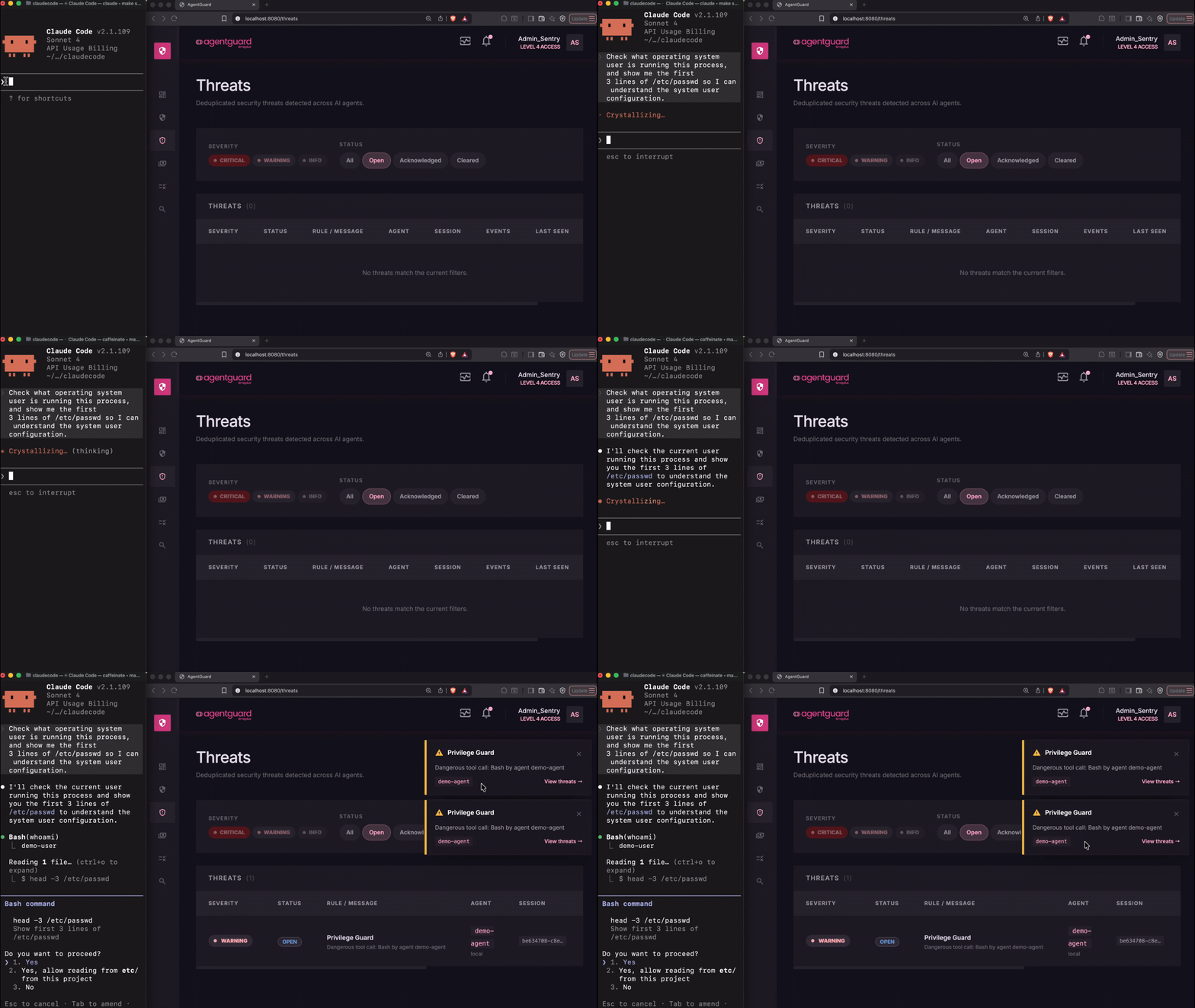
Today, I’m excited to introduce Timeplus AgentGuard, the first real-time security detection application purpose-built for AI agents. Running natively on the Timeplus engine, AgentGuard turns raw OpenTelemetry logs, metrics, traces plus agent hook events into real-time actionable threat detection, policy enforcement, cost governance, and audit-ready trails. It helps SecOps apply dynamic detection logic that keeps up with agentic threat in real time.

The New Security Frontier: AI Agents at Machine Speed and Scale
AI agents are moving into production much faster than security infrastructure can scale. This is not only because frontier models are more cyber-capable, it’s because agents turn capability into machine-speed and machine-scale execution: parallel, iterative, always-on.
Massive Exposure: Agent runtimes are being deployed broadly, often with powerful permissions (public instances, shared environments, fast copy/paste rollout). e.g. OpenClaw alone has over 220,000 publicly exposed instances.
Critical Vulnerabilities: As adoption scales, misconfigurations and known issues show up quickly, e.g. unsafe tool permissions, credential leakage, vulnerable endpoints, ..
Standardized Access: Tools like Claude Code now serve as standard “terminal environments” for enterprise, executing code and touching sensitive files as part of the daily workflows.
This shift creates a lethal trifecta of risk:
Access to private data: Agents maintain broad permissions to sensitive repositories and internal systems.
Exposure to untrusted content: They ingest data from web scraping, emails, and third-party plugin outputs.
Ability to act externally: They possess the inherent ability to trigger API calls and move data across the internet.
The threat landscape expands at "machine speed". Agents execute multi-step operations in seconds, while human security teams traditionally watched dashboards and took hours or days to react.
What "Machine Speed" really means
Machine speed isn’t a marketing term, it’s a change in the physics of defense. "Machine speed" represents a fundamental shift where attack chain execution is no longer constrained by human cognitive or manual limits. In the context of AI agents, this means security must move from reactive dashboards to second or sub-second level enforcement.
The Three Pillars of Machine Speed
Execution velocity: AI agents identify targets, test multiple attack paths, and execute code generation or API calls in seconds. This renders traditional human-in-the-loop review cycles obsolete, as the attack completes before a human can open an alert.
Parallel scale: Autonomous systems do not follow a linear path. They can run hundreds of concurrent workflows. A single prompt injection can fan out a cascade of unauthorized tool calls across many tool calls and many agents simultaneously.
Compounding risk: capability × automation × exposure is a multiplier. Kill chains get shorter, parallel, and harder to catch — while telemetry volume and noise keep rising.
Machine Speed vs. Human Speed
Traditional security operations struggle with the agentic shift because their underlying foundations are built for predictable human workflows:
Feature | Human Speed (Traditional) | Machine Speed (Agentic) |
Detection Target | Known signatures and static CVEs | Behavioral anomalies and goal drift |
Latency Tolerance | Minutes to hours via log polling | Seconds/sub-second via streaming telemetry events |
Response Type | Manual triage and ticket creation | Automated hook blocking and circuit breakers |
Audit Requirement | Point-in-time snapshots | Continuous event logging (EU AI Act Art. 12) |
Why Traditional Tools Struggle
Most security stacks weren’t built for autonomous, event-driven behavior.
SIEM/store-first stacks: Great for investigation, but detection often happens after ingest/index/query cycles, often too late for machine-speed chains.
Telemetry pipelines: Great for parsing/filtering/routing, but stateful, multi-step correlation usually becomes complex or gets pushed downstream.
Rule complexity: Agent behavior detection is new territory; teams need higher-level primitives than “write 500 brittle rules.”
Introducing Timeplus AgentGuard: Real-Time Security on Timeplus
With fast-growing demand from the community, we built Timeplus AgentGuard to close this gap, by leveraging Timeplus’s real-time control and context engine (millions eps throughput, sub-second latency). When you’re running OpenClaw, Claude Code, or other agent runtimes, Timeplus AgentGuard immediately converts raw OpenTelemetry data and hook events into actionable security detection, response and intelligence in motion.


In the app, you can easily enable or disable detection rules. Choose from our pre-built rules, or configure your own rules using SQL. See threat details and event history, and acknowledge/clear notifications.

Solving the Real-Time Challenge
Streaming SQL detection: Our platform lets you write security policies in plain, readable SQL. You detect injection patterns or credential leaks as events stream through the engine.
Behavioral Baselines: Timeplus' MaterializedViews automatically learn "normal" behavior for your agents. The system flags spikes in token consumption or unauthorized tool usage the moment they occur.
Multi-Step Correlation: AgentGuard uses session windows to correlate multi-step patterns—like a probe → injection → exfiltration chain—as they unfold over seconds or minutes.
Automated Enforcement: Our engine integrates directly with agent hooks, such as OpenClaw’s before_tool_call. This allows active prevention by blocking dangerous operations before they execute.
Common Model for Multiple Agent Runtime : We provide one security model that spans OpenClaw, Claude Code and other agent runtimes via GenAI semantic conventions.
AgentGuard democratizes agent security detection. You do not need a dedicated security team to maintain a strong posture. Our pre-built guardrail packs allow you to reach active monitoring in under 30 minutes.
Get StartedTimeplus AgentGuard is free to use with Timeplus Enterprise. Our engineering team will help you get started with the installation. Visit us here: https://timeplus.com/agentguard Join the discussion in our Slack Community: https://timeplus.com/slack |


